
The weight loss conversation changed fast. GLP-1 medications work, they work for a lot of people who had not succeeded with anything else, and the debate about whether they are legitimate is mostly over.
The debate that is very much not over — and the one that actually determines whether someone ends up healthier — is what comes off with the fat.
Because weight loss is never purely fat loss. Any substantial reduction in body weight takes some lean tissue with it, and the research on rapid pharmacological weight loss suggests that share can be considerable. Muscle and bone are not incidental. They are what carries you through your seventies. Losing them to get a smaller number on a scale is a bad trade, and it is an avoidable one.
What the Research Actually Says
Reviews of GLP-1 receptor agonist therapy consistently find that these medications reduce fat mass and lean mass together, and that the lean component can represent a meaningful fraction of total loss — with the largest concerns in older adults and anyone who already had low muscle mass going in. A detailed review of muscle preservation during GLP-1 therapy lays out the mechanisms and the countermeasures.
There is also a behavioral wrinkle that matters. Reduced appetite is the mechanism, and it does not discriminate between calories you can afford to lose and protein you cannot. People on these medications frequently eat far less protein without realizing it, simply because they are eating less of everything and protein-dense foods feel heavy.
Meanwhile, the strongest single countermeasure — resistance training — is the thing that tends to feel hardest when you are eating substantially less.
That is the problem in one sentence: the intervention that drives the weight loss also undermines the two things that protect muscle during it.
The Three Countermeasures
None of this is exotic. It is just rarely structured.
Protein, deliberately. Current practice for adults in an active weight loss phase lands around 1.2 to 1.6 grams per kilogram of body weight daily — meaningfully higher than the general adult minimum, and higher than most people on appetite-suppressing medication are getting without planning. Distribution matters too: spread across meals rather than concentrated at dinner. When appetite is low, this usually means front-loading protein early in the day, when you can still tolerate it.
Resistance training, two to four times weekly. This is the non-negotiable one. Resistance training is the signal that tells the body to hold onto muscle while it is losing weight. Without it, the body has no reason to preserve tissue it is not using. The federal Physical Activity Guidelines set two days a week as the floor for all adults; during active weight loss, more is better.
A pace that is not reckless. Extremely rapid loss increases the lean tissue share. Slower is not just safer, it produces a better body composition outcome at the same eventual weight. If weight is dropping faster than roughly one to one-and-a-half kilograms a week, that is worth discussing with your prescriber rather than celebrating.
Why the Scale Is the Wrong Instrument
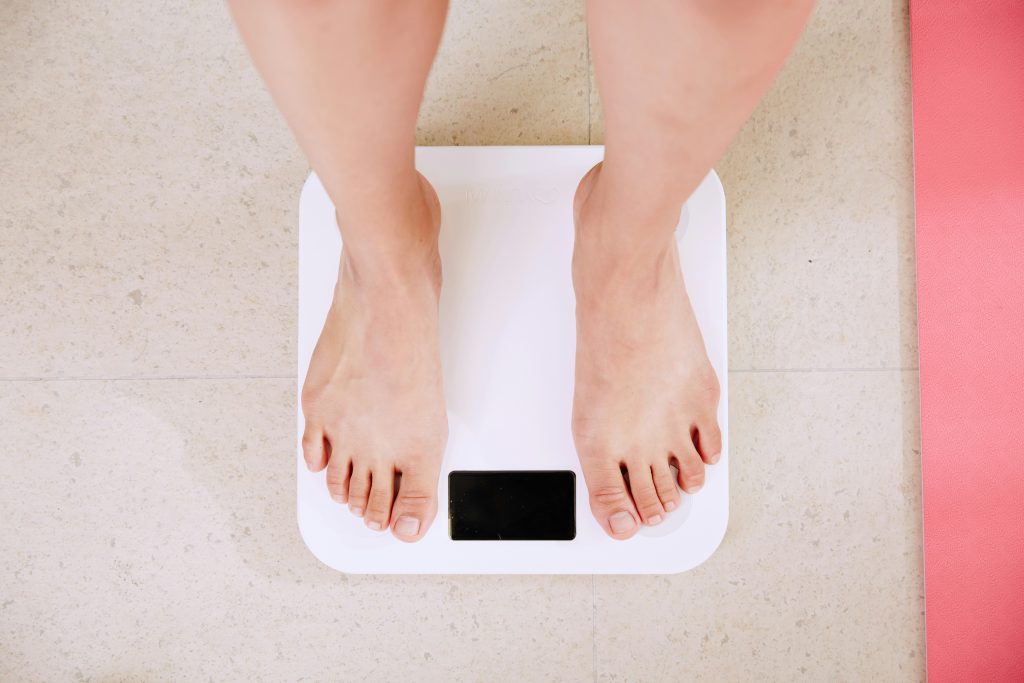
A bathroom scale cannot tell you what you lost. Two people can drop the same twenty pounds and end up in completely different places — one leaner and stronger, one smaller and frailer.
What is worth tracking instead:
- Body composition, not just weight
- Strength markers — grip, a sustained sit-to-stand, whether your working loads are holding or falling
- Waist circumference, which tracks visceral fat better than weight does
- Actual protein intake, measured for a week rather than estimated
- Energy, sleep and training capacity — the subjective markers that usually move first when something is off
If your strength numbers are falling while the scale falls, that is not success. That is a signal to change something.
How We Structure It
Our weight loss program is built around that distinction, because the clinic is set up to handle both the metabolic and the structural side of the problem.
On the metabolic side, functional medicine and nutrition covers the workup people usually skip — thyroid function, metabolic markers, iron and vitamin D status, and the actual dietary pattern rather than a self-reported summary. Low-grade issues that make weight loss harder and muscle retention worse are common and frequently undiagnosed. The NIH’s weight management resources are a reasonable starting point for understanding what a real evaluation should include.
On the structural side, the obstacle for a large share of people is not motivation. It is that resistance training hurts. A bad low back, a cranky shoulder, or knees that complain on stairs will end a strength program in three weeks regardless of intent. That is where chiropractic care and injury rehab stop being a separate service and become part of the weight loss plan — because a person who can train comfortably will train, and a person who cannot, will not.
What Success Should Look Like
A well-run six months looks like: fat mass down substantially, lean mass roughly held, strength stable or improved, waist meaningfully smaller, energy better, and a set of habits — protein, training, sleep — that survive if and when the medication stops.
That last clause is the one to plan for from day one. Muscle you kept is muscle you still have later. Muscle you lost is muscle you have to rebuild, and rebuilding is slower than preserving.
If you are on a GLP-1 now, considering one, or losing weight without medication and want to do it without giving up strength, we are happy to look at where you are and build the structure around it.
WynWellness — 4770 Biscayne Blvd STE 610, Miami, FL 33137 — (786) 899-0595 — https://wynwellness.com